OpenRouter Pricing Guide 2026: Complete Cost Analysis and Model Aggregation
Complete guide to OpenRouter API pricing. Learn how OpenRouter aggregates 200+ AI models, their cost structure, and how to optimize spending through intelligent routing.
PromptCost Engineering Team
Lead AI infrastructure engineers who have collectively spent over $500k on API bills across 12 production deployments.
Quick Answer
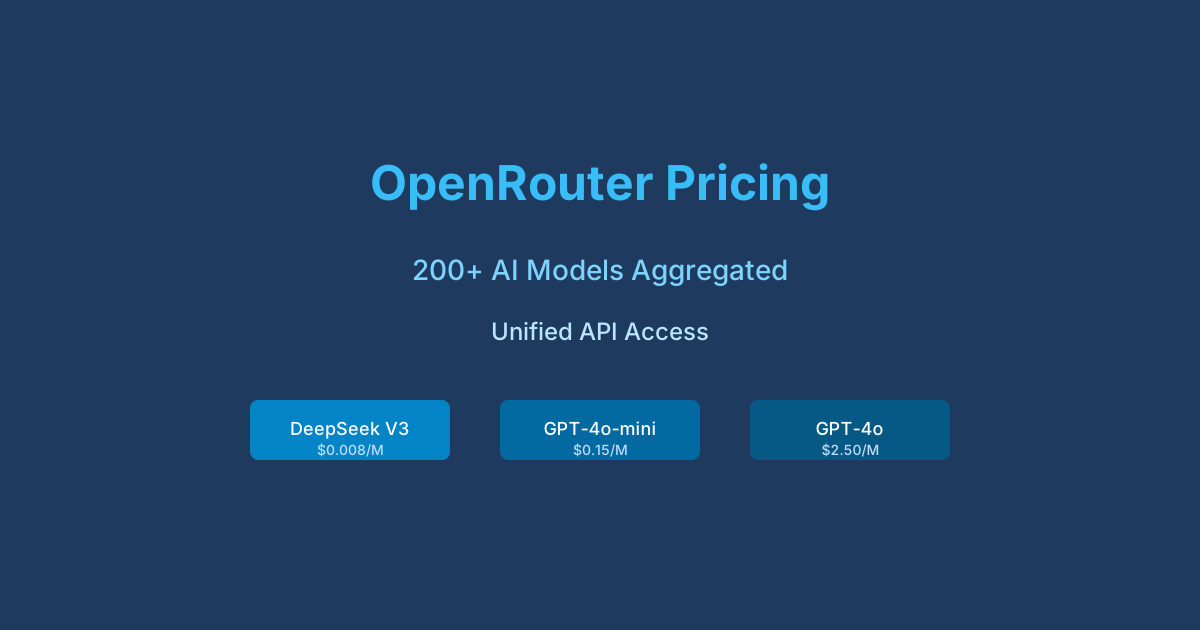
OpenRouter aggregates 200+ AI models through a single API. Cost is model price plus 1% markup. DeepSeek V3 is cheapest at $0.01/M. Use for multi-model routing, automatic failover, and unified access.
Executive TL;DR
OpenRouter pricing works by:
- Charging model-specific rates plus 1% platform fee
- Providing unified API key for 200+ models
- Enabling automatic failover between providers
Key models and costs:
| Model | Input Cost | Output Cost | Provider |
|---|---|---|---|
| DeepSeek V3 | $0.008/M | $0.032/M | DeepSeek |
| Gemini 1.5 Flash | $0.075/M | $0.30/M | |
| GPT-4o-mini | $0.15/M | $0.60/M | OpenAI |
| GPT-4o | $2.50/M | $10.00/M | OpenAI |
How OpenRouter Pricing Works
OpenRouter acts as an aggregation layer. Instead of managing multiple API keys for different providers, you get one unified API key.
Pricing structure:
- Base model price (varies by model)
- Plus 1% platform markup
- Plus minimal routing costs for failover
For example:
- GPT-4o direct: $2.50/M input
- GPT-4o on OpenRouter: $2.525/M input (1% markup)
Cost Optimization on OpenRouter
Tier 1: Budget Models (Under $0.10/M)
For high-volume, simple tasks:
- DeepSeek V3: $0.008/M input - Best for classification, extraction
- Gemini 1.5 Flash: $0.075/M input - Best balance of cost and quality
- Llama 3.1 8B: $0.10/M input - Open source option
Tier 2: Standard Models ($0.10-$1.00/M)
For general-purpose tasks:
- GPT-4o-mini: $0.15/M input - Best overall value
- Claude 3.5 Haiku: $0.80/M input - Strong quality
- Gemini 1.5 Pro: $0.35/M input - Good for long contexts
Tier 3: Premium Models ($1.00+/M)
For complex reasoning:
- GPT-4o: $2.50/M input - Best for coding
- Claude 3.5 Sonnet: $3.00/M input - Best for documents
- o1: $15.00/M input - Reasoning tasks only
Automatic Failover Savings
One key benefit: automatic failover.
If your primary model (e.g., GPT-4o) goes down, OpenRouter automatically routes to a backup (e.g., Claude 3.5 Sonnet).
Without failover: 100% downtime = $0 revenue With failover: 99.9% uptime = near-full revenue
This can save thousands in lost transactions during API outages.
FAQ
How does OpenRouter compare to direct API access?
OpenRouter costs ~1% more but provides unified access, automatic failover, and standardized responses across all models.
Which OpenRouter model is best for cost optimization?
GPT-4o-mini offers the best cost-to-quality ratio for most applications. DeepSeek V3 for budget-sensitive, high-volume tasks.
Does OpenRouter charge for failed requests?
No. Failed requests (due to provider issues) are not charged. You only pay for successful responses.
Conclusion
OpenRouter simplifies multi-model AI access with transparent pricing. The 1% markup pays for itself through unified API management and automatic failover.
:::tip Continue Reading:
- For cost optimization strategies, see Cut AI API Costs 60%
- For AI pricing secrets, read AI Model Pricing Secrets
- For model comparison, see GPT-4o vs Claude vs MiniMax
- For infrastructure cost comparison, see the GPU Rental Index for provider pricing :::
References
- PromptCost.org — AI API pricing data and analysis
- OpenAI Pricing — GPT-4o API pricing
- Anthropic API Pricing — Claude API pricing
Frequently Asked Questions
How much does OpenRouter cost?
OpenRouter charges per token based on the underlying model's pricing, plus a small 1% markup. For example, GPT-4o costs $2.50/M tokens on OpenRouter vs $2.50/M directly from OpenAI.
Is OpenRouter more expensive than direct API calls?
OpenRouter adds approximately 1% markup on top of model pricing. The benefit is unified API access to 200+ models with automatic failover and standardized response formats.
Which models are cheapest on OpenRouter?
The cheapest models are DeepSeek V3 at $0.01/M tokens, followed by Gemini 1.5 Flash at $0.075/M, and GPT-4o-mini at $0.15/M. OpenRouter aggregates these for easy comparison.
How does OpenRouter model aggregation work?
OpenRouter provides a unified API that routes requests to different model providers (OpenAI, Anthropic, Google, etc.) behind the scenes. You get one API key for all models with standardized response formats.
Share this article